

By: The Active Life Team
KEY TAKEAWAYS:
- The fastest way to build an online coaching business is to graduate the in-person clients you already have to remote — not to chase cold strangers online.
- It only works if you set that expectation at enrollment. You can’t convert a client who told you up front they only ever wanted in-person.
- To start, you need one online client, not twenty. Do great work for the one, then teach them to refer their non-local friends.
- Authority is local. Be the go-to inside a 3–5 mile radius, not the whole world. (There are 1.5 million people within 5 miles of downtown Toronto — more than enough.)
- You don’t become the authority by posting more. You become it when influential people who could work with anyone choose you, and refer you.
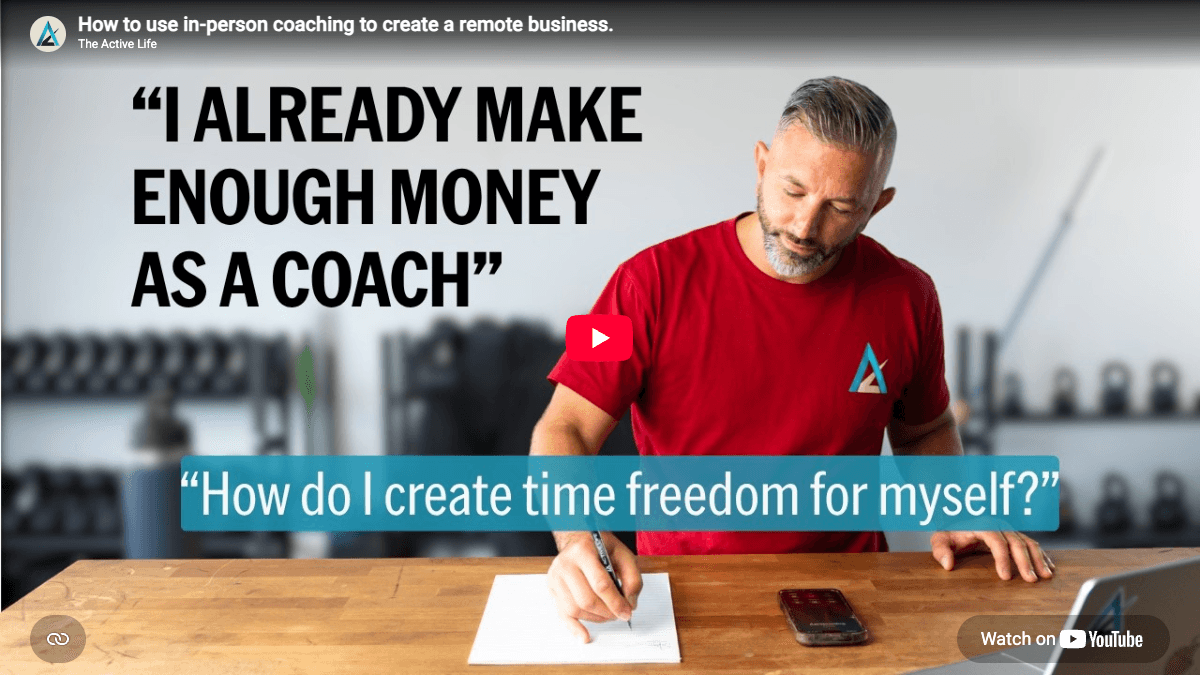
On the Dr. Sean Show, Dr. Sean Pastuch spends about twenty minutes on one coach's single biggest problem. This time it was Alex, a trainer in Toronto with a healthy in-person business — $10,000 to $12,000 a month — who wants to build a remote side so that one day he'll have more time freedom for a family. His plan: hire a videographer, post six videos a month, grow his social media, and become "the guy." His feeling: a lot of doubt, a lot of imposter syndrome.
Sean's response reframed almost the entire plan. If you're a coach trying to build online, this is the part nobody tells you.
What's the fastest way to build an online coaching business?
Graduate your in-person clients to online — not chase new ones on the internet.
When a client no longer needs you standing next to them, you transition them to remote: you charge them less money, give them more access, and it costs you less time. Everyone wins. And there's a second payoff — those graduated clients are the ones who refer their friends who aren't local, the people who can only ever work with you online.
You don't need an Instagram account to do that. You don't need to become famous. You need a path that moves your existing clients from needing you in the room to succeeding on their own with your guidance.
Why isn't converting my in-person clients working?
Because you're trying to convert people who told you from the start they only want in-person.
Alex's frustration was real: he'd run clients through 24 or 36 sessions, go to move them to remote, and hear "my problem's solved, I'm good," and they'd leave. Sean's diagnosis was blunt — the expectation is the problem. If a client tells you up front they see more value in having you next to them, that client is not your future remote client, and trying to force it just creates friction.
The fix is to set the destination at enrollment. From the first conversation, you agree on the plan:
"My goal is to make it so that you no longer need to come see me in person. If you decide you want to keep working with me after that, we'll figure out what that looks like — but I want you to make that decision from a want, not a need."
Most people love that. Then, as they approach the point where they don't need you in the room, you introduce the transition: keep training at any gym you like, on a program I build, checking in regularly, with an in-person session once a month. Because you set it up that way from day one, it lands as the plan working — not as you pushing them out.
Do I have to find online clients online?
No — and assuming you do is one of the most expensive mistakes here.
Sean laid out the ways coaching gets sold:
- Online marketing to online clients. It works, but you have to overcome an enormous amount of non-trust — a stranger deciding you're the authority who should solve their problem sight unseen. This is the hardest path, and it's exactly why coaches burn themselves out trying to "build authority" online.
- Online marketing to in-person clients. Easier — the trust closes when they come see you.
- In-person marketing to in-person clients. Referrals and prospecting. This is how most coaches, Alex included, built their whole business.
The point: looking for online-interested people does not mean you have to sell online-to-online. Alex works out of a brick-and-mortar. He can invite an online-curious prospect in for a consultation, build trust in person, run a short block of sessions to make sure they can execute on their own, and then move them online — with both of them clear from the start that online was always the goal. Don't give up the golden goose. It is far easier to build trust in person.
You don't need twenty online clients. You need one.
The whole thing gets simpler when you stop trying to summon a crowd.
Find one online client. Do a genuinely great job. Then teach that one person how to refer their friends who are online and never have to work with you in person at all. Now you have proof you can help people remotely — because you have the one. It is much easier to find one person than twenty.
Sean's phrase for it: think big, but act really small and local. Acting small and local is what becomes the big thing.
How big does your authority actually need to be?
Smaller than you think. Local, not global.
Sean asked Alex how many people live within three to five miles of him. The answer, once they looked it up: 1.5 million within five miles of downtown Toronto. If you were the authority to those people, would you ever struggle to fill your business? Of course not. Would you lose sleep that someone in Sweden or LA hadn't heard of you? Of course not.
Trying to be the authority to the whole world feels like thinking big. It's actually the mistake. Becoming the authority in your city is far easier, and it's more than enough.
So how do you actually become the authority? (Not by posting.)
Here's the counterintuitive core. You do not become the authority by building a big social media presence. You become the authority when the people who could work with anyone choose to work with you.
"You're the authority when people who everyone else thinks could choose anyone they want to work with — and they chose to work with you."
The method is a referral chain through influential people. Find someone one or two degrees of separation from you who already has that kind of standing and who needs your help. Help them — even for free — do a great job, and let them refer you.
That's exactly how Sean built his own authority. He found the best CrossFit athlete on Long Island (elite athletes always have aches and pains), reached out, and offered to help — no charge, no social media posts, just great work. That athlete referred his girlfriend, who referred her boss, whose boyfriend referred his boss, who had no following but big influence, who referred some of the most elite athletes in CrossFit history — which eventually led to Olympians and professional baseball players finding him. It didn't happen overnight, and it didn't happen without helping influential people first.
And "influential" does not mean a big Instagram following. It means real influence: business owners, community organizers, municipal leaders — the micro-influencers in your actual community. Help them, and let them find the people who need you.
"Everybody wants to be the overnight success on Instagram. It almost never happens. What I'm describing works because nobody's willing to do it."
What Alex is doing differently tomorrow
By the end, Alex's plan had changed. Instead of just posting more and waiting for the right people to show up — the advice he kept seeing on Instagram — he's going to look for influential people in Toronto and actually talk to his existing clients about referrals, the basic work he'd been skipping. As Sean put it: the basic stuff is more important.
You can pour money into video and posting and still not become "the guy." Authority isn't built on a feed — it's built on getting the right people results nobody can argue with, and letting them refer you.
Start inside the assessment system. The L1 Biomechanics & Assessment Workshop is two days, live online, $19 (it was $1,500 in-person).
GRAB A SPOT — $19FAQ
A: Graduate the in-person clients you already have to remote once they no longer need you next to them, and have them refer their non-local friends. Cold online-to-online is the slowest, hardest path because you have to overcome so much distrust.
A: Set it as the plan from day one. At enrollment, agree that the goal is for them to reach a point where they work with you from want, not need. You can't convert someone who told you up front they only ever wanted in-person.
A: No. Authority isn't follower count. You become the authority when influential people who could choose anyone choose you — and refer you.
A: Find someone one or two degrees of separation from you who already has local influence and needs your help. Help them, do great work, and let them refer you. Influence means business owners and community leaders, not necessarily big Instagram accounts.
A: Locally. Being the go-to inside a 3–5 mile radius is far easier than global reach, and it's more than enough to fill your business.
This is from the Dr. Sean Show, where Dr. Sean Pastuch coaches one professional through one problem. The coach here is Alex, a trainer in Toronto. Full episode above.
📖 Every coach should read this one.
Live More. Hurt Less. by Dr. Sean Pastuch is the thinking behind the method — how pain actually works, and why the members who've "tried everything" are still stuck. Read it to sharpen how you coach, then put it in your clients' hands.
ORDER the bookActive Life Professional | Turn Pro.